Determining the Limits of the Imperial Grounds
The identification of the Topoi also allows us to determine the eastern boundary of the palace grounds built by Constantine the Great. According to Codinus, “the triclinia erected by Constantine the Great reached as far as that point,” meaning the Topoi. This statement is important, because it gives us a clear and definite limit for the extension of the earliest imperial palace in Constantinople The Postern of St. Lazarus in Historical Events.
The Topoi therefore marked the furthest eastern point reached by the buildings and open courts associated with Constantine’s palace. Beyond this point, the character of the area changed from imperial residences to public structures and religious foundations.
The Tzykanisterion and Its Extent
The Polo Ground of the Great Palace
Further confirmation of this boundary is provided by references to the Tzykanisterion, or polo ground, which was attached to the Great Palace. Ancient writers state that this sporting ground extended as far as the neighbourhood of the Church of St. Lazarus and the Topoi.
This information is especially valuable because the Tzykanisterion was not a small structure, but a large open area intended for imperial games and displays. Its size and position make it an excellent guide for determining the limits of the palace complex. The fact that it reached the Church of St. Lazarus and the Topoi strongly supports the view that these features lay at the eastern edge of the palace grounds.
For this reason, Dr. Paspates was incorrect in placing the eastern boundary of the palace much farther east, almost reaching Seraglio Point. The literary evidence clearly shows that the palace did not extend so far.
The Topoi and Nearby Monuments
Possible Origin of the Topoi
Codinus raises the question of whether the Topoi may have been the remains of one of the theatres erected by Emperor Septimius Severus in Byzantium. While this suggestion cannot be proven with certainty, it does help explain the presence of stone seating in this location and its continued use as a notable landmark in later centuries.
Regardless of their original purpose, the Topoi became an important point of reference in medieval descriptions of the city’s eastern shore Customized Tours Bulgaria.
The Thermae of Arcadius
A Monument of Imperial Splendour
Near the Topoi stood the Thermae Arcadianae, the great public baths constructed by Emperor Arcadius. These baths were regarded as one of the finest architectural ornaments of Constantinople. Their presence in this area further confirms that the district was one of major public importance and imperial patronage.
Close to the baths was also a church dedicated to the Archangel Michael, known as Michael of the Arcadian Quarter. This dedication reflects the military and protective role often associated with the Archangel in Byzantine religious thought.
The Atrium of Justinian the Great
A Place of Beauty and Leisure
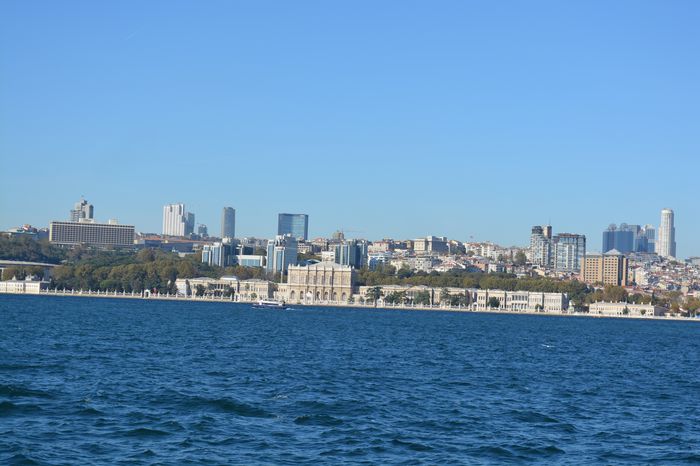
In the same neighbourhood must also have stood the Atrium of Justinian the Great, another important public space. This atrium was especially popular in the late afternoon and towards sunset. At that time of day, the eastern side of the city lay in shadow, allowing visitors to admire the glowing colours reflected on the Sea of Marmora, the Asiatic coast, and the distant mountains.
The atrium was built of white marble and richly adorned with statues. Among these works of art, one stood out above the rest: a statue of the Empress Theodora, set upon a column of porphyry, a material closely associated with imperial authority. This statue was widely admired and remembered by later writers.
By identifying the position of the Topoi and the Church of St. Lazarus, we can define with confidence the eastern boundary of Constantine the Great’s palace. The supporting evidence provided by Codinus, by descriptions of the Tzykanisterion, and by nearby monuments such as the Thermae Arcadianae and the Atrium of Justinian, all point to the same conclusion. Together, these features reveal a carefully planned imperial landscape that combined residence, recreation, public life, and artistic display along the eastern shore of Byzantine Constantinople.